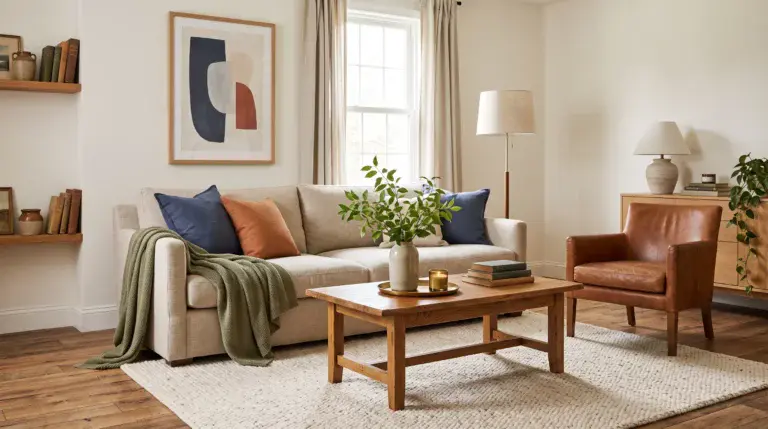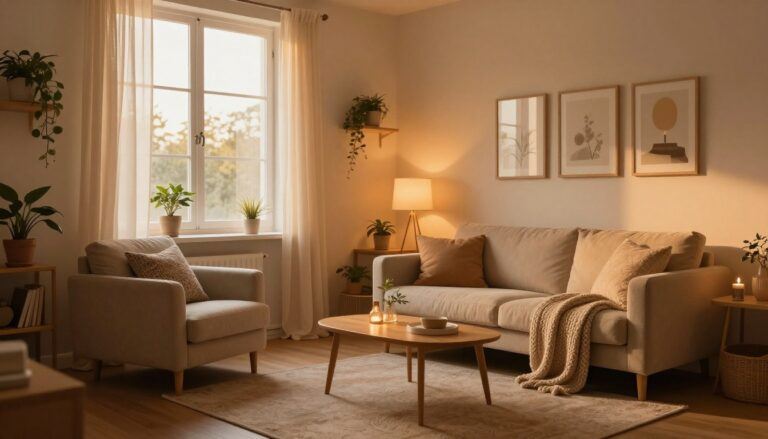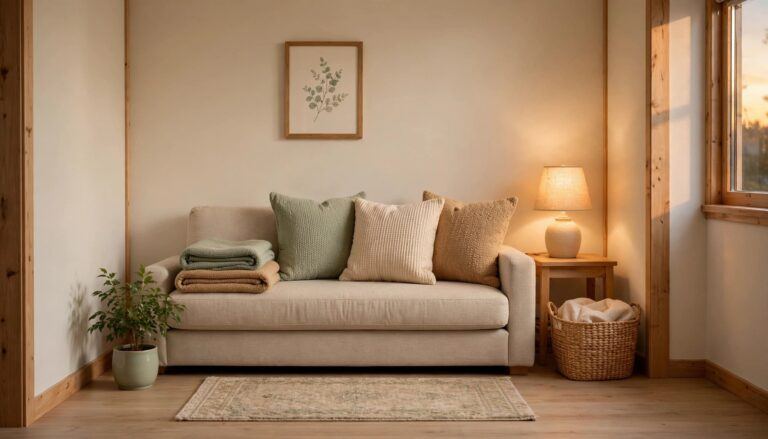

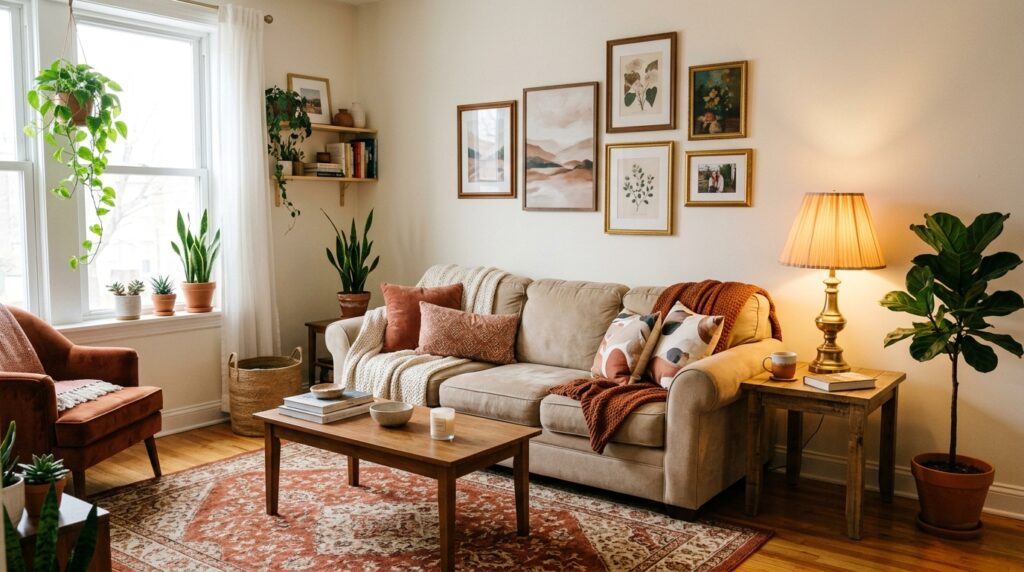
You signed the lease. You picked up the keys. You walked in, looked at those blank white walls (or that suspicious shade of landlord beige), and thought: how do I make this feel like home?
You’re not alone in this. According to the Rently 2025 Apartment Design & Decor Trends Report, which surveyed 500 U.S. renters planning to refresh their homes, 70% say it’s important for their living space to reflect their personal style. But here’s the catch: most leases say no painting, no drilling, no permanent changes.
So you work around it.
The good news? Paint is actually one of the least effective ways to make a space feel cozy. Coziness comes from warmth, texture, lighting, and layering. Things you can control entirely with removable, renter-friendly moves.
Here’s how to do it, with real product examples, price ranges, and the reasoning behind each choice so you can prioritize what matters most for your space.
1. Rethink Your Lighting First (Not Last)
Most renters decorate in this order: furniture, accessories, then lighting as an afterthought. Flip that. Lighting has the biggest single impact on how cozy a room feels, and research backs this up.
A study from the University of California found that amber-toned lighting had the fastest and greatest stress-mitigating effect among tested light colors. Meanwhile, research from Delft University of Technology shows that higher brightness reduces perceived coziness and increases feelings of detachment. In plain terms: dim, warm light makes a room feel like a retreat. Bright, cool light makes it feel like a dentist’s office.
The Rently report found that 79% of renters prioritize gentle, layered lighting to create ambiance. Here’s how to build that layering:
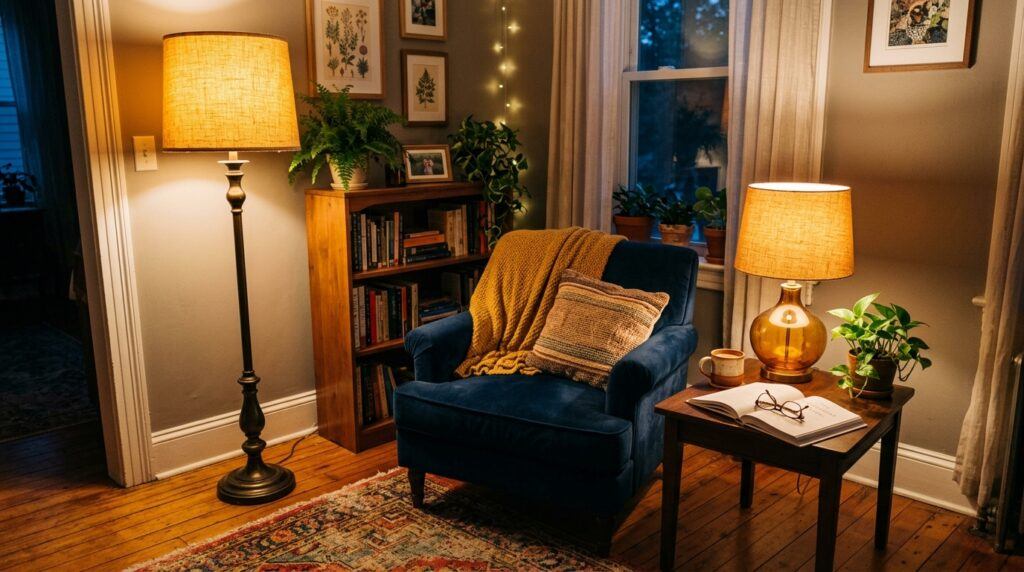
Layer 1: Ambient (fills the room)
- A floor lamp with a fabric or paper shade diffuses light softly across the room. Target’s Project 62 arc lamp runs about $45. IKEA’s NOT floor lamp is under $20.
- Place it in a corner, not next to the overhead light. You want light coming from a different direction than the ceiling.
Layer 2: Task (does a job)
- A table lamp on a side table or nightstand for reading. Look for ones with warm-toned shades (cream, amber, linen) rather than cool white.
- Budget pick: IKEA HEKTAR table lamp at $25.
Layer 3: Accent (adds glow)
- LED strip lights behind a TV, under kitchen cabinets, or along a bookshelf. Govee makes a 16-foot WiFi strip for $20 that you can set to warm white or amber.
- A plug-in wall sconce on either side of a bed or sofa. No wiring needed. Look for ones with a switch on the cord. Aukey and Globe Electric make renter-friendly versions for $25 to $40 each.
The move that ties it together: Replace your bulbs with smart bulbs set to 2700K (warm white). The Philips Hue White Ambiance 4-pack is about $50, but Wyze and Sengled make comparable versions for $25 to $30. Set them to dim automatically in the evening. That warm glow is what makes the difference between “apartment” and “home.”
For more lighting ideas that work in any space, check out our guide to warm lighting ideas for cozy rooms.
2. Go Big With Your Rug
When you can’t change the walls, the floor becomes your biggest design surface. A large area rug in a rich, warm color does more to change a room’s mood than almost anything else.
Color choices that read as cozy: terracotta, deep olive green, warm navy, muted rust, charcoal with warm undertones, or a vintage-inspired pattern with cream and ochre. Avoid cool grays and stark blacks. They feel institutional.
Size matters more than thickness. A 5×7 rug floating in the middle of a room with furniture pushed against the walls looks like an afterthought. An 8×10 (or 9×12 in larger rooms) that your sofa front legs sit on top of? That looks intentional.
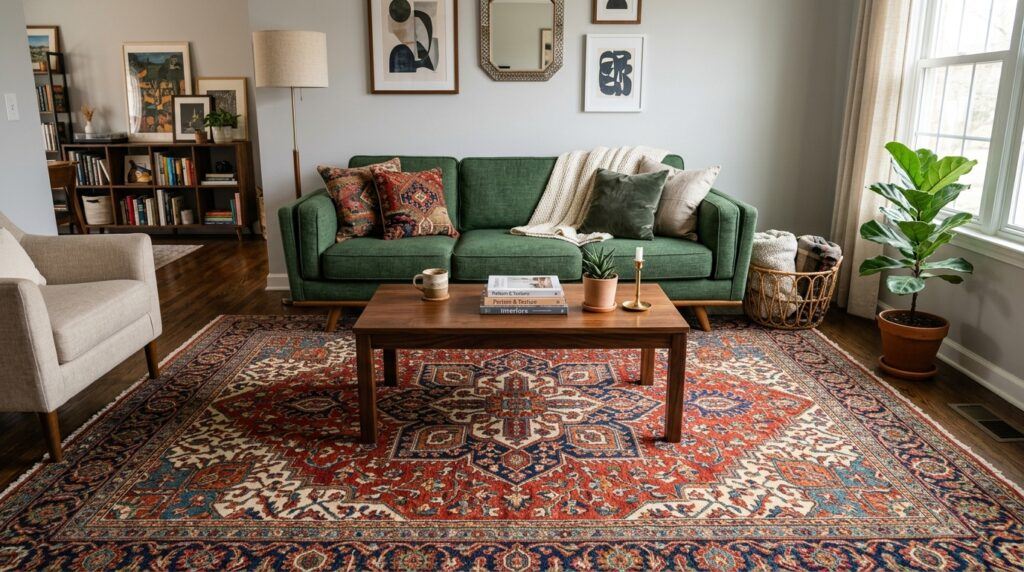
Where to shop on a budget: Ruggable (washable, removable), Target’s Opalhouse line, Wayfair, and World Market for patterns. Thrift stores and Facebook Marketplace often have large rugs for under $50 if you’re willing to clean them.
If your rental has ugly carpet you can’t remove, layering a rug on top is completely fair game. A light rug over dark carpet brightens the room. A patterned rug over beige carpet adds personality, and it is one of the cheapest ways to refresh a space without spending a fortune.
3. Hang Curtains High And Wide
This is the highest-impact, lowest-cost move on this list. It changes how your windows and ceilings look, and it softens the room with fabric.
How to do it right:
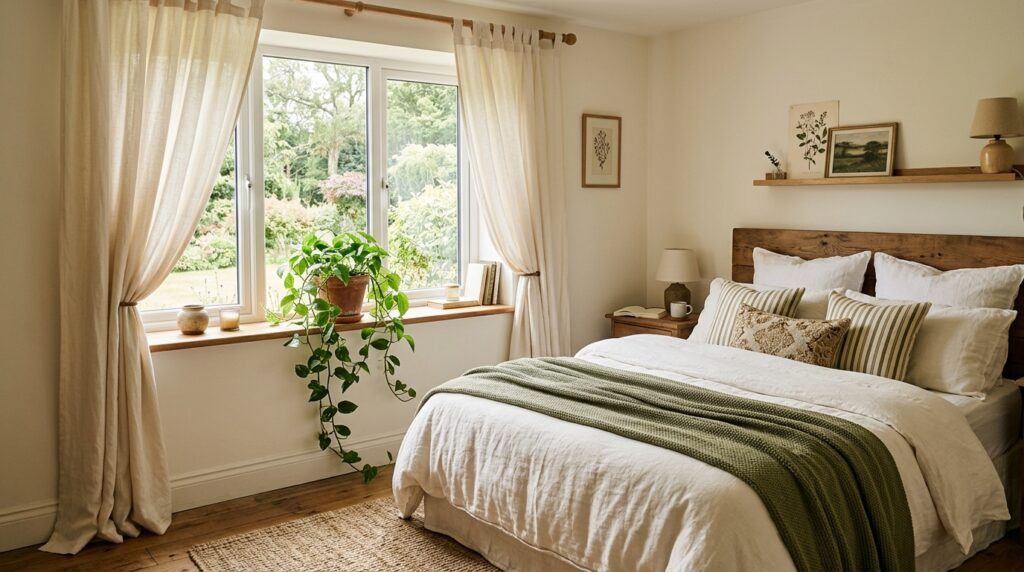
- Mount the curtain rod 4 to 6 inches above the window frame (not inside it).
- Extend the rod 8 to 12 inches beyond each side of the window so the curtains frame the glass rather than covering it.
- Use floor-to-ceiling panels (95 to 108 inches) even if your windows are shorter. That vertical line of fabric draws the eye up and makes ceilings feel taller.
Renter-safe hanging: If you can’t drill, use Command Large Picture Hanging Strips (they hold up to 16 lbs per pair) or tension rods that sit inside the window frame. For a rod that needs to span wider than the window, use a Kwik-Hang bracket that taps into the top of the window frame with no screws.
Curtain choices that feel cozy:
- Linen-blend panels in cream, oatmeal, or soft sage ($20 to $40 per panel at Target or IKEA)
- Velvet panels in deep tones like plum, forest green, or navy for winter months ($30 to $50 per panel)
- Sheer layered under heavier panels so you can adjust for light and privacy
Curtains also work as room dividers in studios or open-plan rentals. Hang a track from the ceiling (there are renter-friendly no-drill options) and use a curtain wall to separate your sleeping area from your living space. Instant bedroom, no construction required.
4. Build A Focal Wall Without Paint
Pick one wall, the one your eye lands on when you walk in, and make it the statement. Here are four approaches, ranked by impact and ease:
Option A: Peel-and-Stick Wallpaper
Brands like Tempaper, NuWallpaper, and Peel and Stick Wallpaper Co. make removable wallpaper that comes off clean from smooth, primed walls. Three rolls cover a standard accent wall (about 30 square feet) and cost $75 to $120 total.
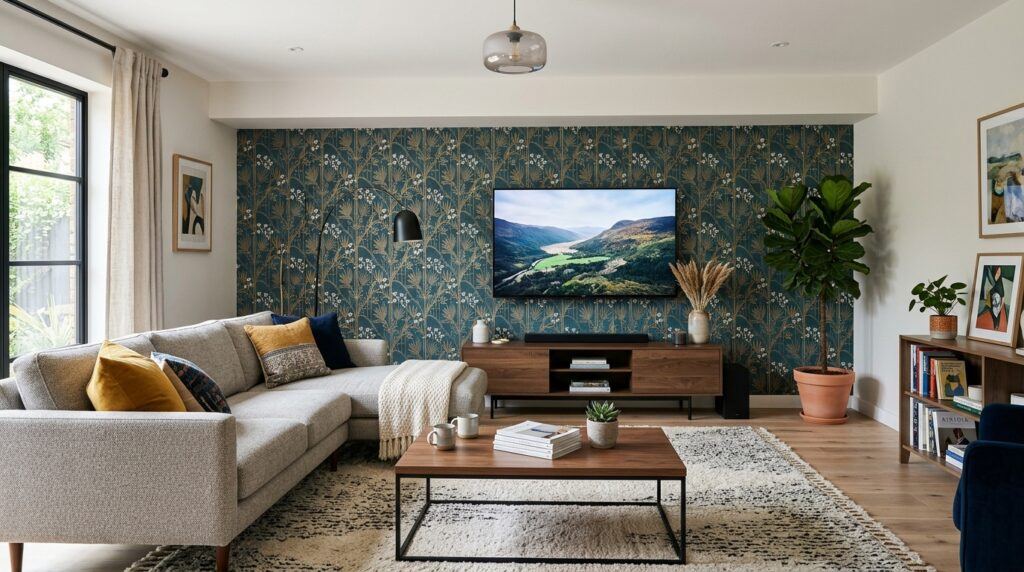
Tip: Test a small strip first in an inconspicuous corner. Some textured walls or flat paint finishes don’t release as cleanly. And stick to one wall. Wallpapering every wall in a rental is a bold move that usually backfires.
Option B: A Gallery Wall
Use Command strips to hang 5 to 7 framed pieces in a loose grid or staggered arrangement. For a cohesive look, use all black frames, all light wood frames, or spray-paint thrifted frames the same color.
Budget approach: IKEA RIBBA frames ($4 to $15 each) plus free printable art from sites like Unsplash or Etsy digital downloads ($3 to $10). Total cost for a 5-piece gallery wall: about $50 including strips.
Option C: Leaning Oversized Art
Can’t hang anything at all? Lean a large canvas (24×36 or bigger) against the wall on top of a dresser, console table, or even directly on the floor. No holes, no damage, big visual impact. Look for oversized prints on Amazon, Etsy, or Society6 for $30 to $80.
Option D: Fabric as Wallpaper
Stretch a beautiful fabric over a large canvas frame (IKEA sells stretched canvas frames for $10 to $25). Or use starch to temporarily adhere fabric directly to the wall. Yes, liquid starch (the kind you use for laundry) works as a removable adhesive for fabric on walls. When you move out, peel it off and wipe the wall clean. This is a classic renter hack that’s been around for decades and still works.
For more ways to dress up blank walls, our cozy living room ideas guide covers wall treatments, styling, and layout tips.
5. Pile On The Textiles
This is where a room goes from “decorated” to “cozy.” After lighting and your rug, textiles are the thing that makes you want to sink into the space.
Here’s the formula:
On the sofa:
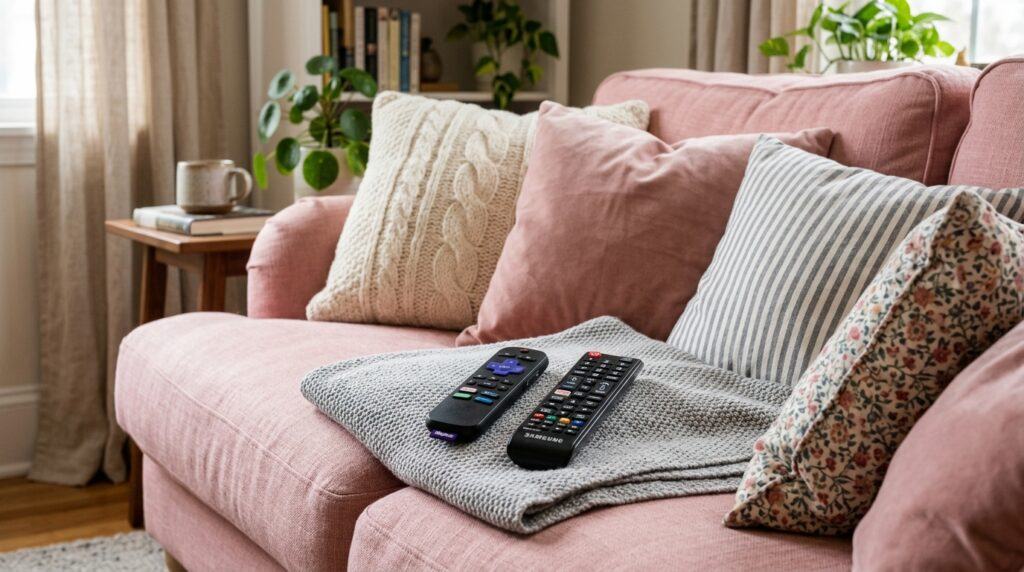
- 2 to 3 throw pillows in warm tones (mustard, rust, sage, cream, terracotta). Mix textures: a velvet pillow, a linen pillow, a woven or embroidered one. Budget: $10 to $25 each at Target, H&M Home, or World Market.
- 1 chunky knit or faux fur throw blanket draped over one arm or the back. Budget: $15 to $40.
On the bed:
- Layer a duvet with a textured quilt or coverlet on top. The visible layering is what makes a bed look inviting.
- Add 2 to 4 Euro shams (the big square pillows) behind your sleeping pillows. They create a “headboard effect” even if you don’t have one.
- A throw blanket folded at the foot of the bed. For more bedroom-specific tips, see our cozy bedroom guide.
On the floor:
- A sheepskin or faux fur rug tossed over a chair, bench, or even directly on top of your area rug. IKEA’s RENS sheepskin is $30 and is a classic cozy move.
On ugly furniture you can’t replace:
- A fitted sofa slipcover in a warm color completely changes a cold gray or navy couch. SureFit and H.VERSAILTEX make stretch-fit covers for $30 to $80 on Amazon. They’re not perfect, but they’re a lot better than staring at a couch you hate for 12 months.
The key principle: mix textures, not just colors. A room with all smooth surfaces feels flat. A room with knit, velvet, linen, jute, and faux fur feels layered and warm. Your eye registers the contrast even if you can’t articulate why it works.
6. Bring In Plants (Start Small, Go Tall)
Plants add life to a room in a way that no inanimate object can. They fill empty corners, soften hard edges, and bring in the natural materials that make a space feel grounded rather than clinical.
The Rently report found that 69% of renters factor pets into their decor decisions, and the same instinct applies to plants: you’re designing around living things, which makes the space feel more personal.
A beginner-friendly plant setup:
If you’re worried about killing plants (fair), start with a snake plant or ZZ plant. They survive neglect better than almost anything else.
Beyond plants, add natural materials in your accessories: a wooden bowl on the counter, a rattan basket holding throw blankets, a jute rug pad, bamboo organizers in the bathroom. These small touches add warmth without any wall contact.
7. Use Mirrors To Bend The Light
Mirrors do two things in a rental: they make small spaces feel bigger, and they bounce light into dark corners. Both make a room feel less cramped and more open, which is essential when you’re working with limited square footage.
Where to place mirrors:
- Opposite or adjacent to a window: reflects natural light back into the room
- Above the sofa or console table: creates a focal point and makes the wall feel less bare
- Leaning against a wall (full-length): no hanging required, adds depth, and you can check your outfit on the way out
A round mirror with a thin frame reads as modern and soft. A sunburst mirror adds personality. A tall leaning mirror makes ceilings feel higher. IKEA’s NISSNA mirror is $30, Target’s Gold Sunburst mirror is about $40, and oversized leaning mirrors run $50 to $90 at Wayfair.
8. Add Scent As A Layer
This one surprises people, but cozy is a multi-sensory experience. How your apartment smells affects how it feels the moment you walk in.

Renter-friendly scent options:
- Candles in warm, grounding scents: amber, cedar, sandalwood, vanilla, fig. Voluspa and Paddywax make great ones for $15 to $25.
- Reed diffusers if open flames aren’t allowed. $15 to $30, lasts 2 to 3 months.
- Essential oil diffusers with a warm light feature. $20 to $35 on Amazon. Use oils like cedarwood, sweet orange, or clove for a cozy atmosphere.
Pick one scent and stick with it for a season. Over time, that smell becomes tied to “home” in your brain. When you switch it up for fall or winter, the change itself feels cozy. For seasonal scent ideas, our seasonal cozy spaces guide has recommendations for every time of year.
9. Define Zones With What You Have
In a rental, especially a small one or a studio, furniture layout does the job that walls and paint usually do. The goal is to make each part of the space feel like it has a purpose, instead of one big room with stuff scattered around.
Moves that create zones:
- Sofa as a divider: Float your sofa in the middle of the room with the back facing the dining or workspace. It separates living from dining without a wall.
- Bookshelf as a partition: Place an open-back shelving unit (like IKEA’s KALLAX) perpendicular to a wall. It defines a reading nook or workspace while still letting light through.
- Rug placement: A rug under the dining table and a separate rug in the living area visually splits the room into two zones.
- Console table behind the sofa: Creates a narrow workspace or entryway surface behind the seating area.
The Rently report notes that 87% of renters would rather stay in than go out, which means your rental isn’t just a place to sleep. It’s your retreat. Defining zones helps it function like a full home, not a single room you happen to eat and sleep in.
10. Swap Out The Small Things That Drag A Room Down
Rentals come with things you can’t change: the blinds, the cabinet knobs, the light switch plates, the bathroom fixtures. But you can work around the small ones.
- Swap cabinet knobs for warm brass or matte black ones. Save the originals in a ziplock bag and swap back when you move. Knobs cost $2 to $5 each at Home Depot or Amazon.
- Cover ugly light switch plates with peel-and-stick contact paper or replace them entirely ($2 each at the hardware store). Save the originals.
- Hide vertical blinds by hanging curtains over them. You can’t remove the blinds in most rentals, but you can install a curtain rod in front of them and keep the blinds open and pulled to the side.
- Add a removable backsplash using peel-and-stick tile. Aspect and Tic Tac Tiles make versions that look like subway tile or marble for $20 to $40 per 10-square-foot sheet. They come off clean when you’re ready to move.
These are small changes, but they remove the “rental tells” that make a space feel temporary. When the details feel intentional, the whole room reads as designed rather than tolerated.
What It Costs: A Realistic Budget
Here’s what a full cozy rental makeover looks like at a budget level. You can spend less by skipping items or thrifting, and you can spend more by upgrading materials and sizes.
The Rently report found that 38% of renters spend between $101 and $500 on decor, and 29% are willing to spend up to $1,000. So this budget falls right in the middle of what most renters are already spending. You can also spread these purchases over several months instead of buying everything at once.
The Bottom Line
Making a rental feel cozy without painting comes down to five things: lighting, rugs, textiles, vertical surfaces, and scent. Get the lighting warm and layered. Put down the biggest rug you can fit. Pile on textures. Dress up one wall with removable wallpaper, art, or fabric. Make the room smell like somewhere you want to be.
None of it requires a paintbrush, a drill, or your landlord’s permission. And when the lease ends, every single item comes with you to the next place.
The Rently report showed that 60% of renters already use removable decor to personalize their spaces. You’re not making a compromise by skipping paint. You’re making a smarter, more flexible choice that lets you create a home you actually want to come back to, without losing your deposit.
Now go make that rental feel like yours.